
Taking up jeans sounds like a small job—right up until the presser foot reaches that thick side seam. That’s where a useful denim machine needs to earn its place.
For most home repairs and denim projects, we’d start with the Singer Heavy Duty 4452. Its adjustable foot pressure and included clearance plate make a practical package. If you’re sewing jeans regularly, the Janome HD3000 deserves a closer look; if your work is almost entirely straight stitching, the Juki TL-2010Q offers a more specialized setup.
Our first choice for home denim projects
Singer Heavy Duty 4452—a sensible choice for hems, repairs and canvas bags, with accessories that address layers and bulky seams. Buy it for that package, rather than the promise of industrial strength.
Choose for the denim work you actually do
| Your projects | Our pick | The useful difference |
|---|---|---|
| Jeans hems and practical home sewing | Singer 4452 | Clearance plate and walking foot included |
| Occasional repairs alongside lighter sewing | Brother ST371HD | Simple controls and a useful everyday stitch selection |
| Regular jeans making on a mechanical machine | Janome HD3000 | Adjustable foot pressure and a leveling button on the standard foot |
| Long straight seams and topstitching | Juki TL-2010Q | Speed control and thread trimming; straight stitch only |
These are US models. Check the exact seller, voltage, returns and accessory bundle before ordering. Denim weight and seam construction vary too much for a universal “sews X layers” promise.
Singer Heavy Duty 4452
Best practical package for denim repairs
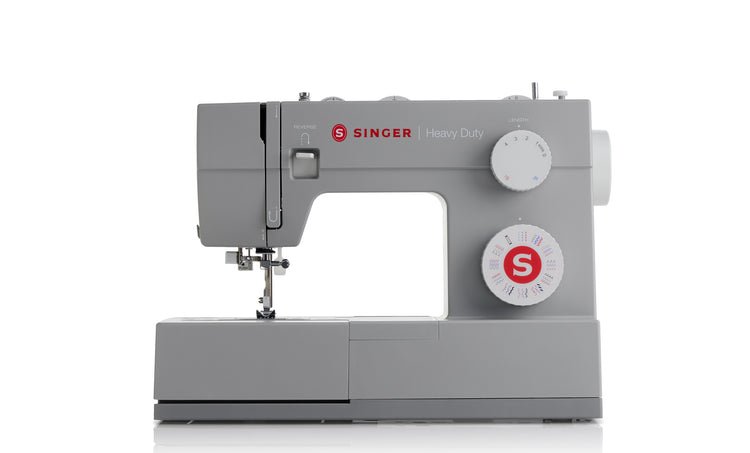
A hem needs more than enough room to slide the jeans under the foot. The foot also has to stay reasonably level as it climbs from a flat section onto the side seam. The 4452 comes with a clearance plate for that job, plus a walking foot to help feed layers together. That’s a better starting point for this guide than a long list of decorative stitches.
You also get adjustable presser-foot pressure, a top-loading bobbin, a needle threader and a one-step buttonhole. There are 32 built-in stitches; the advertised 110 “stitch applications” count techniques, rather than 110 separate patterns.
We’d choose it for a household that repairs jeans, makes the odd canvas tote and wants a conventional machine for everything else. The included non-stick foot may be handy for other projects, but it wouldn’t influence our denim decision.
Before buying, compare the Singer 4423 on Amazon. If it’s substantially cheaper and you already own compatible accessories, its smaller stitch selection is unlikely to hold back your jeans hems.
Where we’d be cautious: speed is controlled with the pedal, without a separate speed-limiting slider. The 1,100-stitch-per-minute maximum is of little interest at a bulky seam. Practice slow starts on a scrap before approaching your favorite jeans.
Explore the Singer Heavy Duty 4452 specifications and included accessories
Brother ST371HD
Best for occasional denim repairs
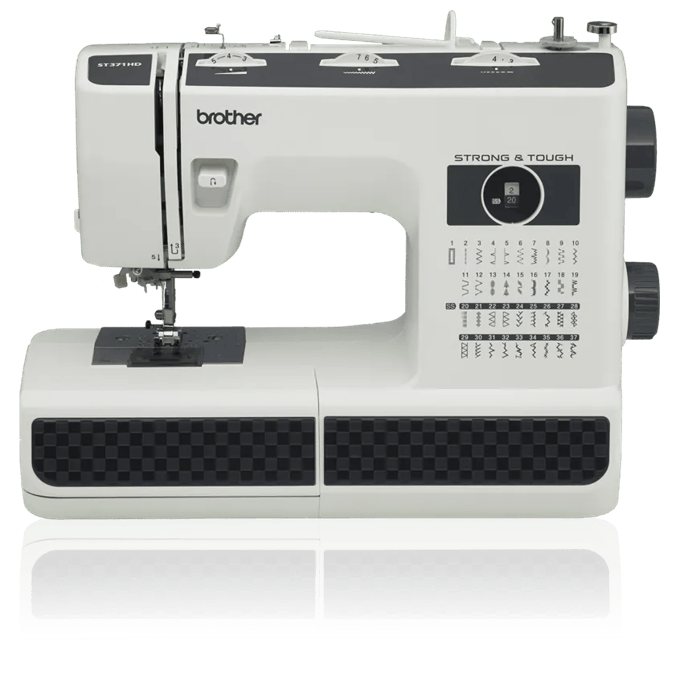
Perhaps denim is one job in the mending pile, alongside a torn pocket and a curtain that needs shortening. The ST371HD makes sense as that kind of general household machine, particularly if its price sits comfortably below the Singer package.
Its dial controls, automatic needle threader and drop-in top bobbin keep the setup familiar. The 37 stitches include everyday utility and stretch stitches, plus a one-step buttonhole; six feet cover tasks such as zippers and blind hems. You can repair the jeans, then get on with making something completely different.
The trade-off is adjustment. Presser-foot pressure is fixed, and there isn’t a separate speed limiter. We’d spend more on the Singer or Janome if experimenting with different denim weights is becoming part of your hobby. For a handful of repairs, you may have no reason to pay for those extra controls.
The Strong & Tough name still describes a domestic machine. We wouldn’t choose it for production runs of heavyweight workwear, or assume that a demonstration on flat denim proves it will cross every waistband junction. Try a sample that reproduces the troublesome seam.
Explore the Brother ST371HD specifications and included accessories
Janome HD3000
Best mechanical upgrade for regular jeans making
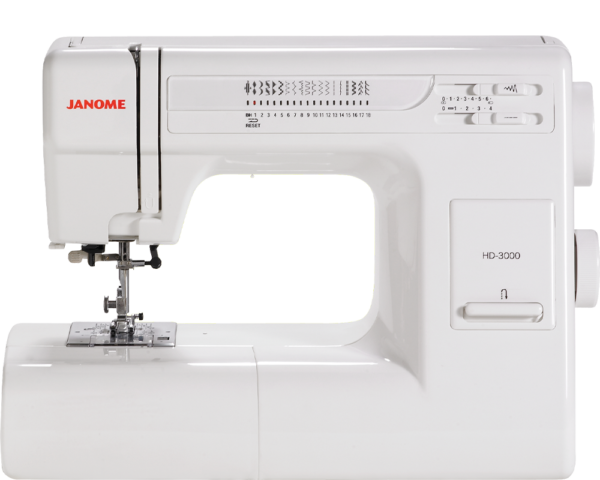
Once you’ve made one pair of jeans that fits properly, making another becomes awfully tempting. The HD3000 is our mechanical upgrade for that stage: a machine with useful fabric-handling adjustments, without a screen full of stitch menus.
The standard zigzag foot has a small leveling button for starting on heavy fabric. Adjustable foot pressure gives you another setting to work with, while the extra-high foot lift helps with positioning the project. That lift is clearance for loading fabric, not a promise that every thickness will sew successfully.
You get 18 stitches, an automatic buttonhole, a top-loading bobbin and a needle threader. The hard cover is a welcome extra if the sewing room is also the spare bedroom.
We’d want a demonstration before paying the premium over the 4452. Bring denim offcuts folded into the seam you intend to sew, ask to start slowly and check both sides of the stitching. A dealer who can help with that test may be worth more than an accessory bundle you’ll barely use.
Choose the HD3000 because you like its controls and the way it handles your samples. We’d be wary of paying extra solely for a brand reputation, a motor-amperage comparison or the words “heavy duty”. None tells the whole story at the needle.
Explore the Janome HD3000 specifications and included accessories
Juki TL-2010Q
Best specialist for straight seams and topstitching
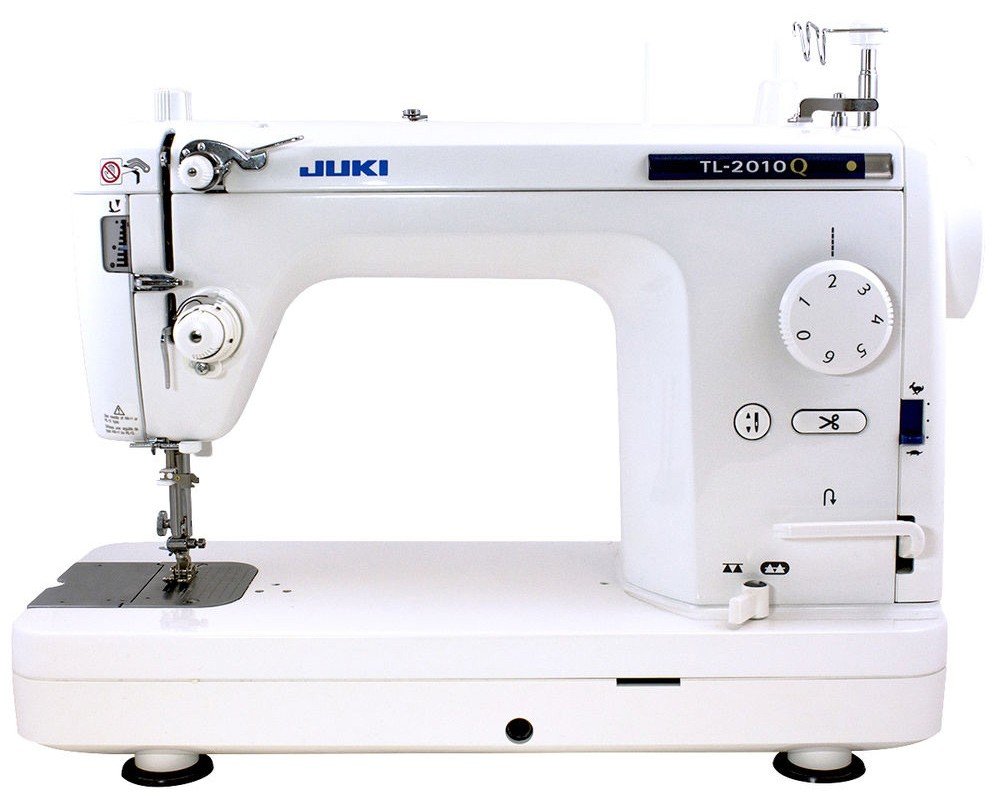
A dedicated jeans maker can spend a lot of time changing between construction thread and topstitching thread. If you have space for a second machine, the TL-2010Q is the specialist we’d consider for long straight seams and carefully placed topstitching.
Its speed slider, needle positioning, adjustable foot pressure and knee lifter give you useful control through repeated stops and turns. Automatic thread trimming is another welcome convenience across a project full of separate seams. Check the manual’s thread restrictions before using the cutter with heavier thread.
It only makes a straight stitch. You will need another machine for zigzag and automatic buttonholes. That makes it a poor first purchase if you want one machine to take jeans from cut pieces to finished garment.
The extension table supports the fabric, but the flat-bed layout also means there’s no free arm for slipping a trouser leg around. At 25.4 pounds, this is a machine we’d give a proper place to live.
Buy it when straight stitching is enough of your sewing to justify the expense and space. It remains a household sewing and quilting machine, not an industrial compound-feed machine for any thickness of denim or upholstery.
Explore the Juki TL-2010Q specifications and included accessories
What matters at a thick jeans seam
Test the junction, not just the fabric
A flat piece of denim can behave very differently from a folded hem crossing a bulky seam. Before judging your current machine—or buying another—make a sample with the same fabric, thread and number of folds. Start slowly, check that the fabric feeds, and look underneath for loops or uneven stitching.
If the machine stalls, the needle bends or the fabric stops advancing, stop. Pushing the fabric or trying to power through adds strain without fixing the setup. A heavier machine can still struggle with a poorly prepared seam.
Give the foot a level starting point
A clearance plate supports the foot while it crosses a change in thickness. A walking foot helps feed fabric layers together. They address different problems, so “walking foot included” doesn’t mean you’ll never need help over a seam hump. Follow your machine and accessory instructions for fitting and positioning them.
The HD3000 manual illustrates its leveling-foot technique on the page titled “Straight Stitching on Heavy Fabrics”. It’s a useful example of the sort of detail we’d look for in a machine demonstration.
Match the needle to the fabric and thread
A fresh jeans needle is an inexpensive place to start. SCHMETZ’s jeans needles have a reinforced blade to reduce deflection in dense fabric. For thick denim seams, its needle guidance suggests starting around 90/14 and considering 100/16, depending on the fabric, thread and machine. Stay within the needle sizes your machine accepts and test first.
Don’t assume the thick decorative thread you want on the outside belongs in the bobbin too. Check the machine manual and thread instructions. A successful sample is much more useful than a universal tension number from the internet.
Before you buy a denim machine
Do I need a new machine just to hem jeans?
Possibly not. If your present machine handles the actual seam sample with a suitable needle and setup, keep it. The money may be better spent on needles, a compatible leveling aid and learning the technique. A new machine makes more sense when your regular projects expose a limit you can describe.
Can these machines sew heavyweight raw denim?
There isn’t a reliable yes-or-no answer without the fabric weight and seam construction. Ask for a demonstration on your intended material, including belt-loop and waistband junctions where relevant. For repeated work in very heavy denim, speak to a dealer about the appropriate industrial setup before ordering a domestic machine.
Is an industrial walking-foot machine the obvious upgrade?
Only when it suits the work. An industrial machine may need its own table, motor setup and maintenance, and its stitch capabilities can be specialized. It is a bigger change than buying a stronger version of your current home machine.
Which would we buy?
The Singer 4452 for a practical home denim package; the Janome HD3000 for a mechanical upgrade, after a successful test on your fabric. The Brother is a sensible option when repairs are occasional, while the Juki earns its place when straight stitching becomes a substantial part of your sewing.
For a wider mix of fabrics and projects, see our best sewing machines for home use. If you’re learning from scratch, our beginner guide puts the controls and first projects first.
About our selections
We compared manufacturer specifications, instruction manuals, standard accessories and current Amazon product listings, with particular attention to foot pressure, seam-leveling aids and the limits of domestic machines. This is a research-led guide; the recommendations are our editorial judgment. Product information and links checked September 5, 2026.